
POWELL PERALTA
*
POWELL PERALTA *
Santa Barbara, California
Founded 1978
_________________
17 skateboards in collection
Overview
Founded in 1978 by product designer George Powell and professional skateboarder Stacy Peralta, Powell Peralta combined technical development, team building, graphic identity and filmmaking with unusual precision. Its Bones Brigade brought together many of the defining skateboarders of the 1980s, while the artwork of Vernon Courtlandt Johnson—better known as VCJ—gave riders enduring symbols drawn from tattoo-like skeletons, animals, and reptiles with a mythic vibe.
Powell Peralta’s videos did more than promote its team and products. They carried new tricks, personalities and places into homes and small towns far beyond California, allowing skateboarders to study movements they might otherwise never have seen. For an entire generation, videos including The Bones Brigade Video Show, Future Primitive, The Search for Animal Chin, Public Domain and Ban This became part entertainment, part instruction and part invitation.
Through its equipment, graphics and carefully constructed team identity, Powell Peralta helped define how skateboarding looked, moved and imagined itself during the 1980s.
-
My first understanding of Powell Peralta came through my friend Ryan’s blue Per Welinder XT model deck in 1986. Before that, I had ridden a strange generic complete that looked vaguely like a painted-over Santa Cruz Roskopp 1. The Welinder was unmistakably a real professional skateboard. Its VCJ graphic had a Viking-like helmet and runes in the background. We were already roaming the local fields, making swords and doing what would probably be called LARPing now, so that imagery connected immediately. The board seemed like an artifact from a complete and invented world.
Then came The Bones Brigade Video Show. Living where I did, on the rural outskirts of metropolitan Detroit, videos and magazines took time to reach us. Aside from Thrasher magazine, which we would drive to a larger town to find, there was almost no way to see what skateboarders elsewhere were doing. A video could carry a new trick across the country with new clarity.
I first saw a kickflip in the Video Show, and it seemed possible because of the mistakes I had made while learning the basic ollie. The board already wanted to roll over sometimes; I had to learn how to make it happen on purpose and have it stay under me. When I did, I remember thinking I had learned it sooner than anyone else I knew in my small town. Kickflips became a source of pride for me: frontside and backside 180 kickflips, half-cab kickflips, heelflips and whatever other variations I could figure out. Skateboarding gave me the confidence of realizing, “Wow—I can do something this unique.” All of that grew from seeing that one trick on a Powell Peralta videotape.
Powell was enormously important to me, but I didn’t identify strongly with a particular Bones Brigade rider. The team seemed polished, selected and somewhat closed off. Maybe that was simply how the videos presented them. Santa Cruz’s Wheels of Fire felt more open and inclusive, with many different types of personalities skating around the world. Powell Peralta felt more like the school; Santa Cruz felt like the scene.
Later Powell videos pulled me in through street skating. Watching Ray Barbee, Chet Thomas and Steve Saiz flow down the street made you want to go outside, ride with your friends and find that same feeling. I was attracted to the skating more than the team identity. Powell taught me before I ever really chose it.
I avoided Powell decks for a long time, apart from my attraction to the original VCJ graphics. Collecting eventually brought me back. Powell was too important, and I wanted all the major team riders represented. I regret not buying more of their earliest wheel-welled models when they were still obtainable. I was collecting early enough to have the opportunity, but I didn’t yet fully understand how scarce and expensive they would become.
Around 2002 or 2003, I finally began riding Powell decks—but they were unsold boards from around 1991. Nobody seemed particularly interested in them, or maybe too many had been made, and I could buy them for less than they had cost new. I skated two Frankie Hill Ears, a Lance Mountain Doughboy 2 and a Mike McGill Fish Fang. I was tired of popsicle shapes, had built another mini halfpipe in my Chicago yard and wanted something closer to the shapes I had grown up riding. Some boards become collectible because everybody protected them. Others become collectible because almost nobody thought they needed protecting. I remember thinking that maybe skating them would help decrease their numbers…lol.
My relationship with Powell became personal years later at Ride It Skateboard Park in Detroit, created by my friend Mitch Cope. Tony Hawk had contributed money to help Mitch finish the park and came to skate it while Joe Brook photographed him for Thrasher. I had recently written the foreword to a privately published book about skateboard collecting, so I signed a copy from Dick & Betty’s Skateboard Museum and gave it to Tony. In return, he handed me the board he had ridden that day and inscribed it to me with “DTW.”
While the three of us were together, Mitch told Tony that I was probably one of the reasons Ride It existed. I had helped bring skateboarding—and especially ramp access—into Mitch’s life years before. I would never have made that claim myself, but it meant a great deal that he said it.
I also met Lance Mountain at Ride It when he came to participate in a Matthew Barney performance involving a skateboard fitted with graphite so that the deck could function as a drawing instrument. Again, this was documented by photographer Joe Brook. Later, at Mitch’s house, I asked Lance to sign my mint Doughboy. He was tired but gracious. He talked openly about Powell and its riders, then drew a Doughboy-style Ripper on the topside and signed it for me.
Powell Peralta’s videos helped skateboarding travel across the country to a kid like me. That influence passed from me to Mitch and, over decades, became part of a Detroit skatepark that Tony Hawk helped finish. Then Tony gave the future museum the board he rode there.
That is how culture travels: from a video to a kid, from that kid to a friend, from the friend to a skatepark—and eventually back to the skateboarder who first appeared on the screen.
TEAM MODEL
1987
BUG (bonite)
STEVE CABALLERO
1987
Dragon & Bats(bonite)
PER WELINDER
1987
Nordic Skull (bonite)
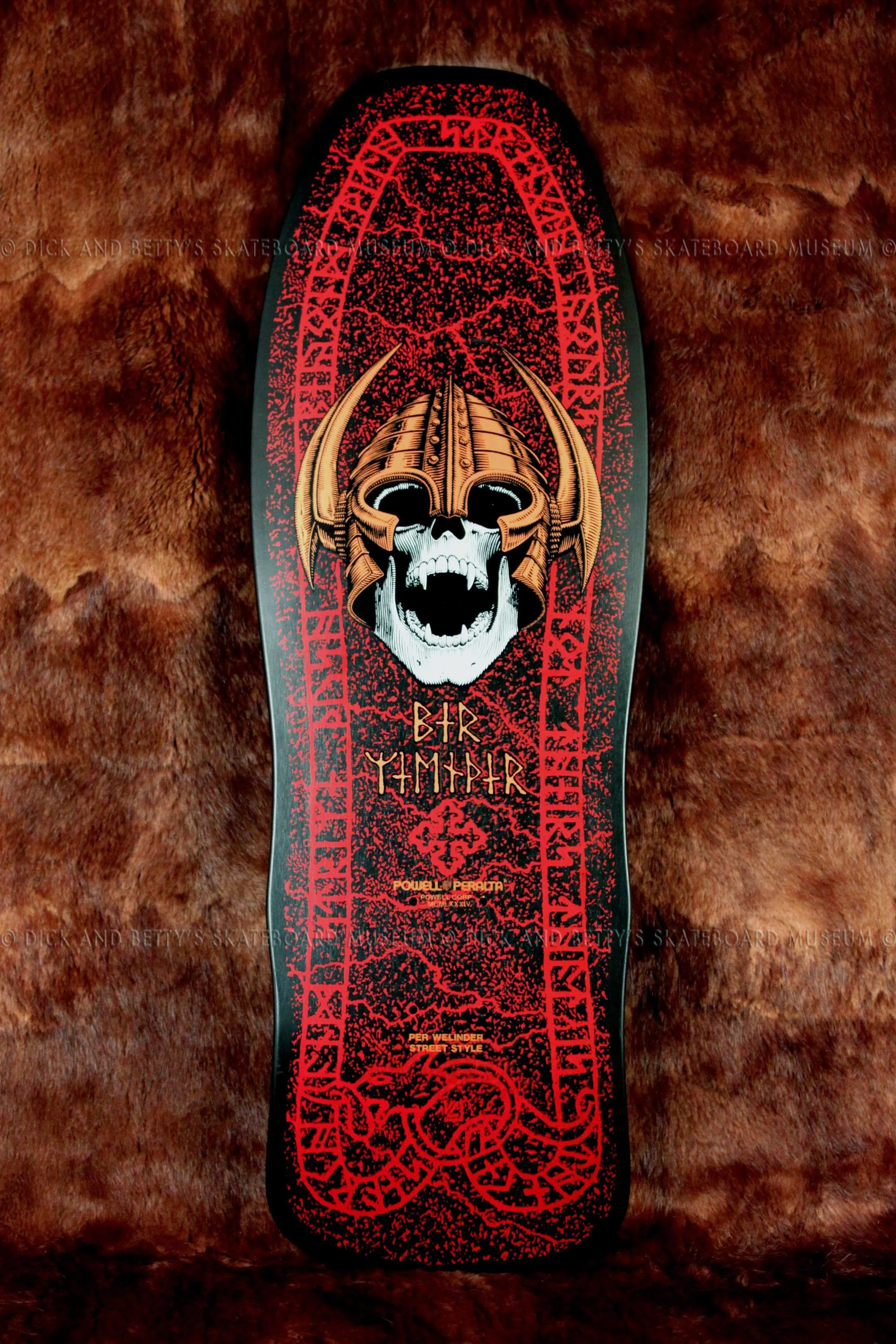
PER WELINDER
1988
Nordic Skull (Street model)
TOMMY GUERRERO
1988
Dagger
STEVE CABALLERO
1988
Dragon & Bats
TONY HAWK
1988
Iron Cross
LANCE MOUNTAIN
1988
Future Primitive
RAY BARBEE
1989
Ragdoll
TONY HAWK
1989
Claw
MIKE MCGILL
1989
Skull & Snake
LANCE MOUNTAIN
1989
Family
MIKE VALLELY
1989
Elephant
FRANKIE HILL
1990
Ear
BUCKY LASEK
1990
Stadium
MIKE MCGILL
1991
Sea Snake
LANCE MOUNTAIN
1991
Doughboy II