
SANTA CRUZ
*
SANTA CRUZ *
Santa Cruz, California
Founded 1973
____________________
12 skateboards in collection
Overview
Founded in Santa Cruz, California, in 1973, Santa Cruz Skateboards grew out of NHS, the company established by Richard Novak, Doug Haut and Jay Shuirman. It became one of skateboarding’s longest-running manufacturers, producing influential decks, wheels, videos and team identities across several generations of the culture.
Santa Cruz developed an especially recognizable visual language through artist and art director Jim Phillips and the artists associated with Phillips Studios. Rider graphics such as the Salba Witch Doctor, Jeff Kendall End of the World and Corey O’Brien Reaper joined company symbols such as the Screaming Hand to create a strange, colorful illustrated world around the brand. Its magazine advertisements extended that identity through grotesque humor, exaggerated color and imagery designed to be nearly impossible to overlook.
Videos including Wheels of Fire, Streets on Fire and Speed Freaks carried Santa Cruz’s riders and personality far beyond California. Together, the company’s boards, graphics, advertisements and films helped establish a version of skateboarding that could be aggressive, humorous, imaginative and open to many different kinds of skaters.
-
Even the name Santa Cruz did something to me. It sounded fresh—like crisp ocean air and California colors. Like Dogtown, it was a simple name that already contained a whole place and way of being. From the rural outskirts of metropolitan Detroit, Santa Cruz belonged to the same distant world as Swatch, Ocean Pacific, palm trees and the Pacific Ocean. Before I ever reached California, the name made California appear like a skate-surf paradise.
My first real pro-oriented skateboard was a white 1986 Santa Cruz Special Edition—the board I called the Mechanical Fish. I received it for Christmas after choosing it at Bike City, a tiny bicycle shop in Highland, Michigan. It was the first skateboard I assembled as a complete system. You chose the trucks and wheels, figured out the rails and protective plastics, drilled the holes and made decisions about every part to create your own custom setup. Mine had black Gullwing Pro III trucks with metal baseplates, green Vision Shredder wheels and black plastics: a Nose Bone, rails and a Tail Dome. I used different-colored sex bolts to attach everything. It was completely 1980s—electric, excessive and personal.
That first complete also began my fascination with Gullwing trucks. What started with those black Pro IIIs eventually became a collection of its own. I now have nearly every color of the later Pro IIIs with the Ultralite baseplates, along with many other variants. One skateboard can send you down several collecting paths without you even realizing it at the time.
At Bike City, while I was there with my father, I also saw a Santa Cruz Salba Witch Doctor. That graphic blew my mind, but I was far too embarrassed to ask for it because of the seductive, voodoo-like lady pictured on the board. I chose the Mechanical Fish instead. Looking back, the Witch Doctor was the first graphic to plant the seed that would eventually grow into Betty’s Archive.
The Mechanical Fish traveled with me. It went to Florida, where my parents heard about a nearby ramp and drove me over sandy dirt roads through a landscape that felt tropical compared with Michigan. Nestled in the vegetation beside one of those sandy roads was an enormous vert ramp completely slathered in pink paint. Nearby, in a tiny skate shop whose name I no longer remember, I bought my first pair of high-top Vans—black with pink palm leaves. These were a huge score. I returned to Michigan feeling like I had brought back something nobody around me could find.
That Special Edition skateboard also traveled west with my family, across the Dakotas and through the Badlands and Grand Tetons, into the Pacific Northwest, past the redwoods and down through California before returning to Michigan. I remember the board as something that moved with me while my understanding of the world was becoming larger.
I later replaced the Vision Shredders with first-generation fluorescent-green Santa Cruz Bullet wheels. I had seen them advertised in the back of Thrasher, surrounded by loose bearings and radiating lines. I was young and gullible enough to think the illustration showed some kind of switch or mechanism that made the wheels go faster. Unlike the speed of things today, I mail-ordered them from California and waited six weeks or more for them to be delivered. When they arrived, I discovered they were just regular wheels with no fancy contraptions. After coming to terms with my disillusionment, I decided I still liked them better. They looked slicker, and I remember being able to push my powerslides farther. I was learning about wheel durometers.
Santa Cruz advertising had a way of pushing things. The ads were so bright, garish and strange that they demanded attention in the magazines. Wheels might appear on a plate of food as if they had just been vomited up. The colors were almost aggressive. Even when you did not completely understand what you were looking at, you remembered it.
The deck graphics created an entire world of their own. The figure forcing a missile into the planet and the hands squeezing and exploding the Earth on Jeff Kendall decks, Corey O’Brien’s Reaper throwing a ball of fire, the Salba Witch Doctor and all the strange skeletal creatures surrounding them seemed less like product illustrations than scenes from some tumultuous universe. Each rider’s board stood on its own, but together the graphics created an aura around the company. Santa Cruz sounded like a place you wanted to reach, and the graphics showed you what might be living there.
What is strange is that I did not consciously think about Jim Phillips at the time. I may have seen his name, but we were not standing around discussing Jim Phillips and VCJ as artists in the way collectors do now. Pushead somehow registered as an individual artist, but most skateboard graphics seemed to emerge from the companies themselves. It was only after I got into art and later began collecting that I understood how an artist could connect so many images and give a company its visual identity.
The videos strengthened that world. Wheels of Fire, Streets on Fire and Speed Freaks showed different personalities, different styles of skating and people moving through places far beyond my immediate surroundings. Jeff Grosso shaving off his eyebrows was impossible to forget. Santa Cruz seemed inclusive because the videos also showed skaters who rode the company’s wheels but might ride for another board company—or might not yet be fully professional. The Santa Cruz riders felt easier to imagine knowing and skating with than the first generation of the Bones Brigade. Powell Peralta felt like the school; Santa Cruz felt like a larger scene.
After my Alva Bill Danforth Circle of Skulls cracked, I bought a used Santa Cruz Klaus Grabke Exploding Clock from my friend Eric for around twenty dollars. He had already worn the tail down slightly, but the deck still felt like a rock. It had a slight, comfortable concave and an incredible amount of spring. Something about its wood, shape and tail angle produced the highest ollies I had done. The Mechanical Fish lasted, and the Grabke lasted too. Their rock-hard Santa Cruz maple earned my trust.
Those childhood boards eventually disappeared into the trash. At the time, a worn or broken skateboard was simply used equipment. We had no reason to imagine that the objects beneath our feet would become historical artifacts—or that we would spend decades trying to find them again.
It took until around 2009 for me to ride a Santa Cruz deck again. I was on Oahu shortly after the birth of my first child and was not skating as much. There was a concrete skatepark near where I was staying, but I had not brought a board. I kept looking at the park until I decided that I had to skate it. I went to a local shop and bought a contemporary reinterpretation of the Slasher, with the creature grinding along the edge of a pool.
The deck felt lighter and not quite as hard as the Santa Cruz wood I remembered from the 1980s, but skateboard construction throughout the industry had changed. What mattered was that Santa Cruz carried me back onto a skateboard in Hawaii. The company whose name had once represented the distant California coast to a kid in Michigan had become the board I chose when I found myself beside the Pacific Ocean again.
When I began collecting, I also returned to the boards that had stayed in my memory. I now have several exceptional Special Edition completes in different colors, although I am still missing pink. My current white example came through the Skull and Bones skateboard collectors’ forum. Another collector knew I was searching for a better one and traded it to me straight across for my more heavily used example. The replacement had once been set up but remained undrilled for plastics, with only the slightest tail wear. It is one of the cleanest surviving examples I have encountered.
The Salba Witch Doctor reached the museum through the same online community. An Australian collector who went by Big Kahuna Burger owned one, and I felt as though one of my last chances to acquire it might be disappearing. I probably pushed him a little to sell it, but he was generous enough to let me have it for what he had paid. The deck traveled from Australia to Michigan, decades after I had been too embarrassed to ask my father for the one hanging at Bike City.
That journey is part of the object now. Skateboards do not stop moving after people stop riding them. They pass among skaters, shops and collectors, crossing oceans and sometimes traveling around the world before arriving in a museum.
Santa Cruz was my first experience of a professional skateboard as something I could choose, construct, alter, ride and carry into the world. It began with a white Mechanical Fish in a small Michigan bike shop, traveled with me toward the places its name had made me imagine, and years later put me back on a skateboard beside the Pacific.
Some skateboards represent a company. That one represents the moment skateboarding became mine.
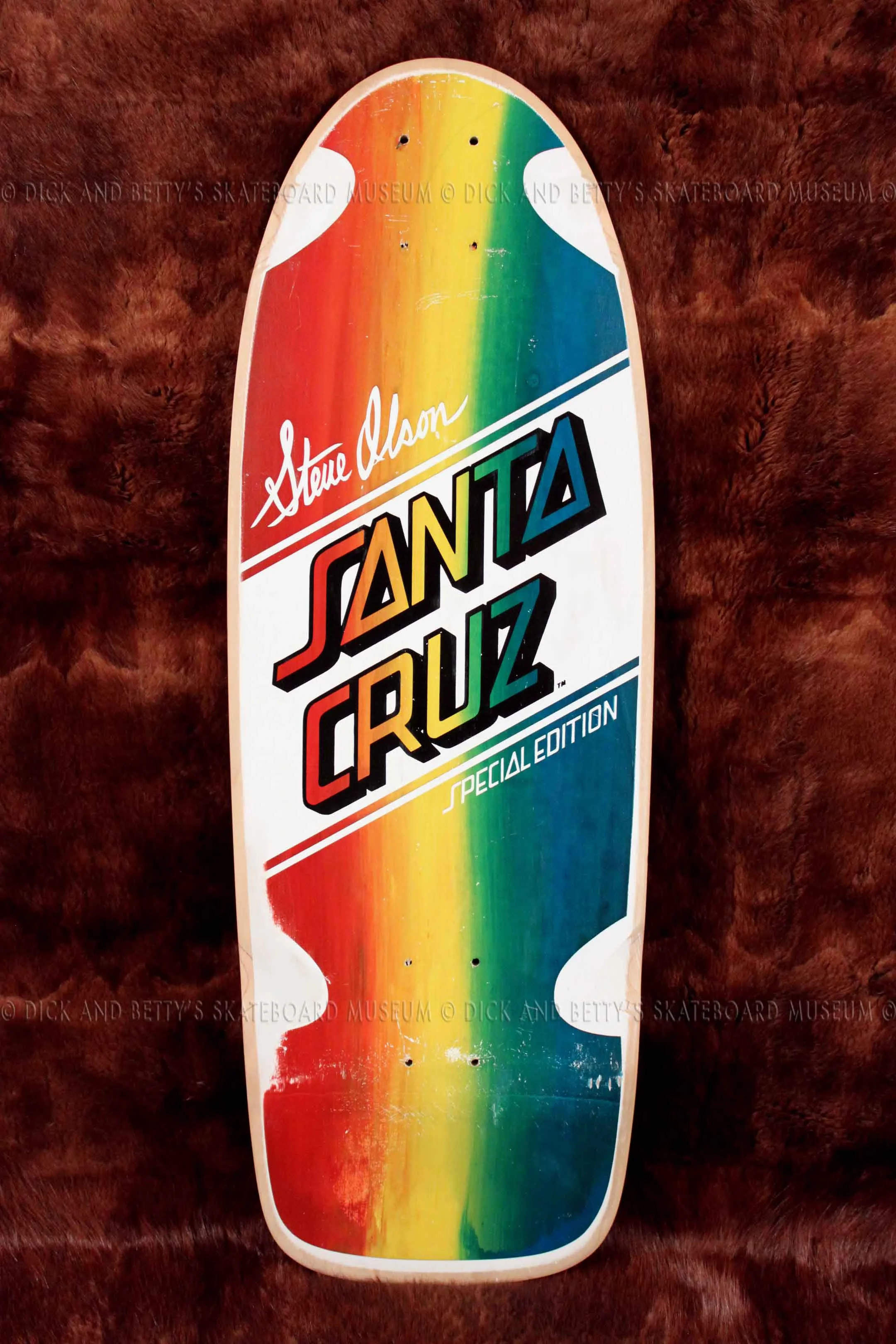
STEVE OLSON
1982
Special Edition

TEAM
1986
S.E. “Mechanical Fish”
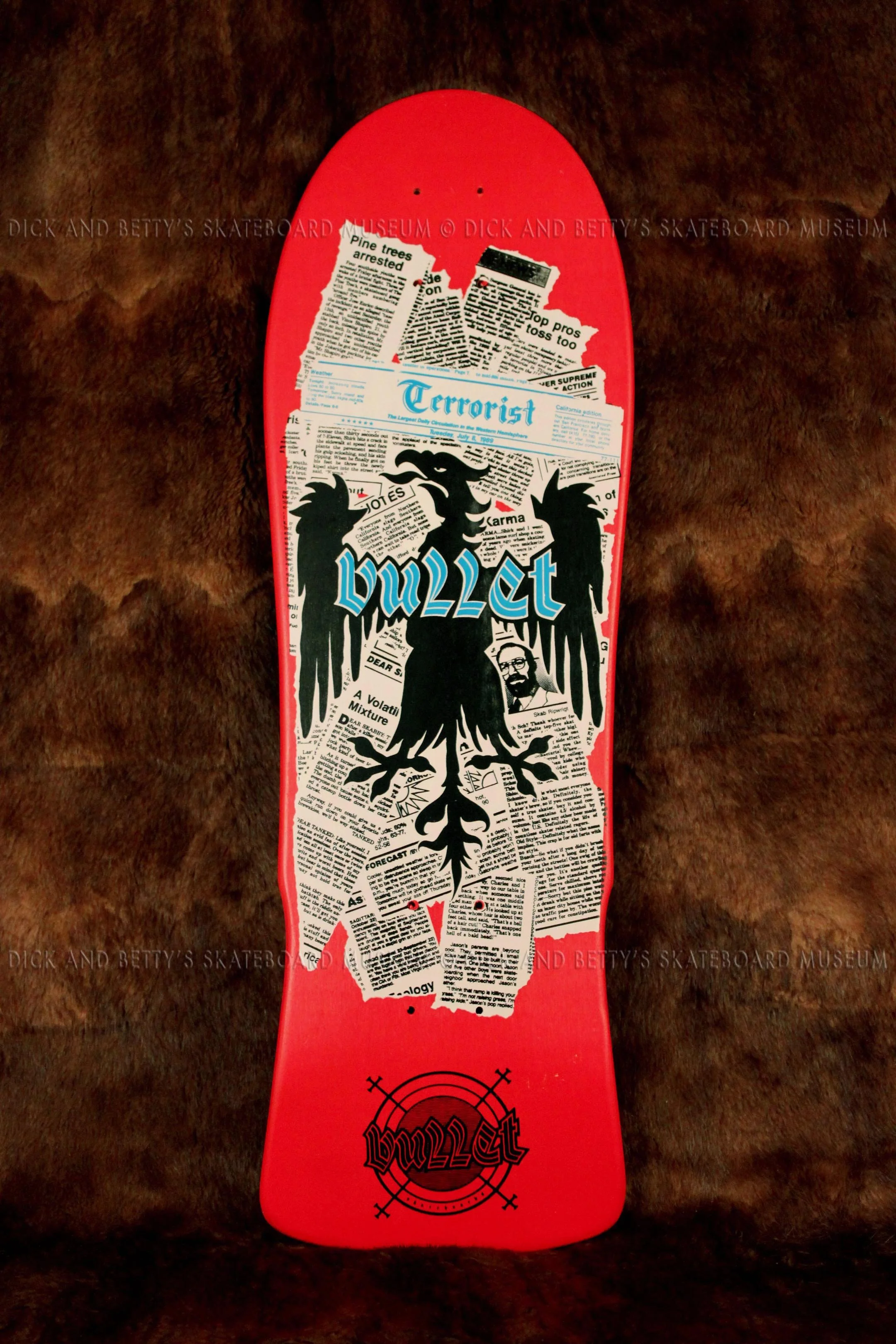
TEAM
1986
Terrorist
KEITH MEEK
1986
SLASHER foam model

STEVE ALBA
1987
Witchdoctor
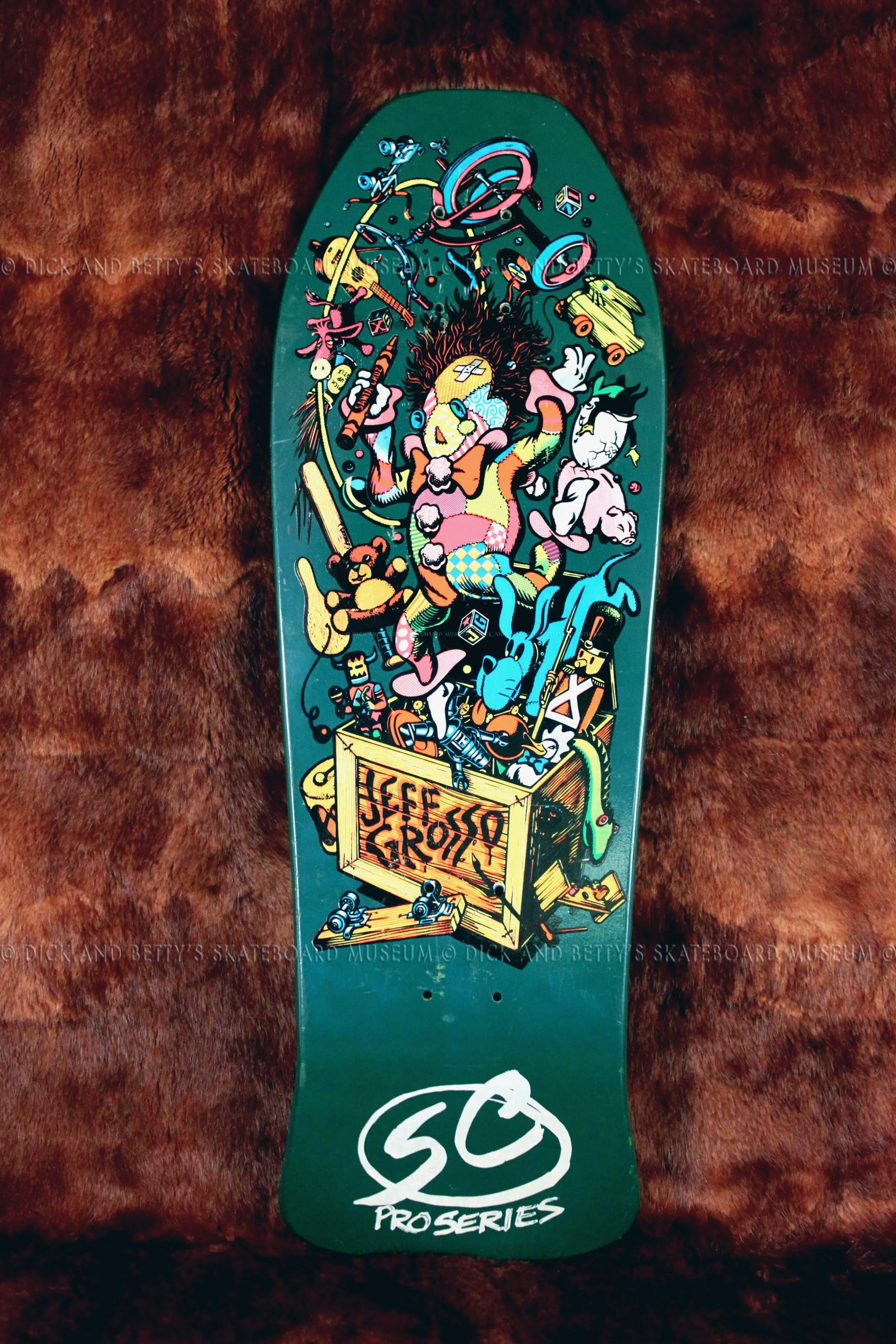
JEFF GROSSO
1987
Toybox
TEAM
1989
Street Creep
TEAM
1990
Logos

COREY O’BRIEN
1990
Purgatory

ROB ROSKOPP
1990
Target Eye
ERIC DRESSEN
1991
Tribal